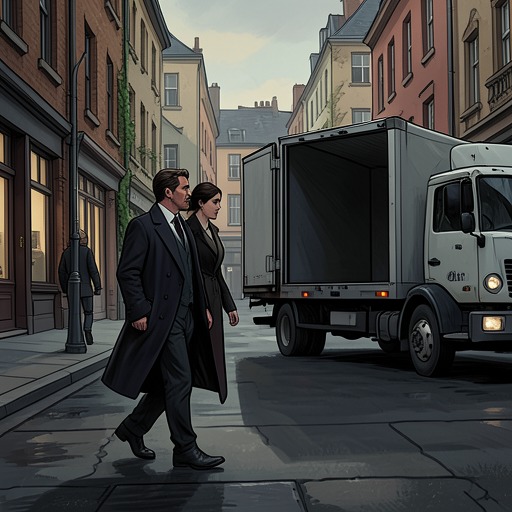
Furniture delivery van used to abduct Zoe
The CageThe Furniture delivery van used to abduct Zoe Hardy is both a practical instrument of the crime and the clue that exposes it. The abductor uses it to bring materials to Zoe’s home and remove a concealed, increasingly heavy crate; footage of that change turns an apparently routine delivery into evidence that Zoe is inside.
Preparation and purpose
Before driving to Thomson Road, the man checks the van’s supplies: an empty tea chest, packing materials, twine and a tub of beeswax. He puts the twine and beeswax into separate jacket pockets, then takes the beeswax back out and sets it beside him in the driver’s seat. The evidence records the objects and their handling, but does not specify what each is intended to do. Their presence nevertheless establishes that the journey is prepared rather than incidental: the vehicle carries a selection of materials before it reaches Zoe’s house.
At the house, Zoe’s car is on the drive. The man hopes this means she is home, though he recognizes that the car might instead have been left there before she went out. He parks at the roadside, takes the beeswax, walks up the path and kicks a couple of stones aside. These small actions place the van within an ordinary residential setting. Nothing in the account describes a conspicuous arrival; the vehicle is waiting nearby while the man goes to the house.
The van’s importance is clearest in the sequence of removal. The man first opens its back in readiness, returns inside, and then carries the bulky crate out of the house. He takes it over the threshold, down the steps, along the cleared path and across the pavement to the vehicle. Because he cannot see his feet while carrying it, he has already checked the path for stones or other obstacles. At the van he lowers the crate onto the back ledge, pauses to recover, slides it farther inside and closes the roller shutter. He then goes back to shut the house’s front door, returns to the van and drives away. The journey ends with the crate concealed in the vehicle, which the narration presents as the means by which he takes Zoe from her home.
The van in the abduction
The account emphasizes the difficulty of moving the crate, not speed or force. The man anticipates that its bulk and weight will make it hard to carry without dropping it or attracting attention, and he proceeds carefully. He balances the load, takes steady steps and checks the route. The van makes this laborious movement possible: the crate can be placed inside, pushed out of immediate view and transported away. Its usefulness lies in that sequence of loading and departure, rather than in any special feature of the vehicle described in the evidence.
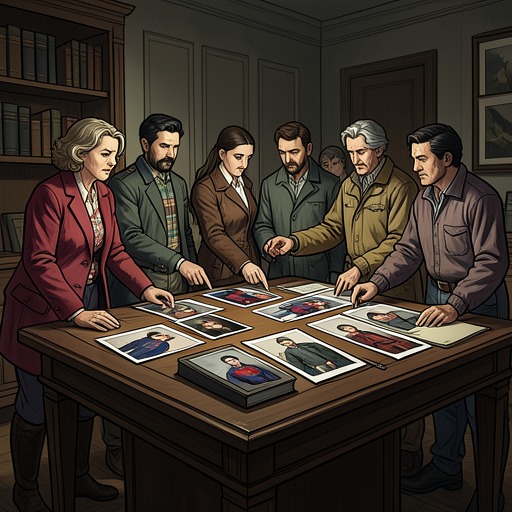
The later security footage makes the change in the crate’s weight legible. A home-security system belonging to the man across the road records the van and its driver arriving at Zoe’s house. Paul Forrester shows the footage to the investigators. It first shows the man entering the house; after several minutes, he returns to the van, takes a packing case from its back and carries it inside. The footage then advances to his later exit with the same case. On the outward journey he struggles, although he had little difficulty carrying it in. Eve Strong recognizes the implication: Zoe is inside. The vehicle has thus served twice in the scene, first as the source of the case and later as the means of taking it away.
The discrepancy between the easy inward carry and the difficult outward one provides the decisive visual change. The footage does not merely show a van at an address; it records a before-and-after comparison. The case’s altered weight indicates that something has been added during the man’s time inside, and Eve identifies that addition as Zoe. The back of the van, initially a place for equipment and a packing case, becomes the concealed destination of the abduction.
Evidence and investigative context
The footage arrives after investigators have already considered how women might be taken without attracting attention. Becky Allsopp’s movements are last traced after she leaves the Metro at Stadium of Light and passes beyond CCTV coverage. Louise Usher’s route home from the gym varies: she sometimes walks, sometimes takes a bus and only occasionally uses a taxi. Across the cases, investigators suspect that victims have been bundled into vehicles, but note the absence of reports of shouting or screeching tyres. These details establish a problem of opportunity and observation: ordinary journeys and gaps in surveillance leave the precise moment of disappearance unseen.
The van’s role in Zoe’s case is more directly documented than that early hypothesis. It appears in footage from a house opposite hers, and the recording captures the driver’s actions at the property. After the investigators return from a raid on Martin Smith’s house, Eve receives the news that footage of the van and driver is available. At the incident room, Paul plays it for the team; Eve sees that the driver is not Martin Smith, then the change in the crate leads her to conclude that Zoe is inside. The discovery both redirects suspicion away from Smith and gives the investigation a concrete account of the abduction.
Jill Richards’s disappearance supplies a related but distinct vehicle clue. CCTV shows her walking towards Roker Avenue, appearing at a bus stop outside the Salvation Army, checking the timetable and flagging down a car that looks like a black cab. Eve notes that police had warned people to hail only white cars bearing a taxi sign. That apparent cab belongs to the investigation of Jill’s abduction; it should not be confused with the furniture delivery van used at Zoe’s house. Together, the cases make vehicles important to the inquiry in different ways: one presents itself as a taxi, while the other carries a packing case whose changed weight gives away its purpose.
Narrative significance
The van’s ordinary function is part of its narrative force. It transports supplies and a crate, and the man can move between vehicle and house while performing tasks that the footage initially records as separate, unremarkable actions. The object becomes incriminating through their order: arrival, entry, delivery of the case, a long interval indoors, and a difficult removal. The same vehicle that helps hide Zoe also leaves a trace that investigators can interpret.
Its significance therefore rests on a reversal. From the abductor’s perspective, the van provides a way to remove Zoe from the house; from the investigators’ perspective, it connects the driver to the property and makes the concealed change in the crate visible. The security system across the road preserves what the act depends on keeping unnoticed. The vehicle is not simply transportation in the plot: it is the moving link between the home, the concealed crate and the evidence that reveals Zoe’s presence.